Business Income Tax Calculator Pakistan
This Business Income Tax Calculator Pakistan tool estimates your tax liability as a sole proprietor, partner in an AOP, or private limited company. Enter your annual turnover and net taxable business income to see your estimated tax, including Pakistan’s minimum turnover tax where it applies.
🇵🇰 Pakistan Business Tax Calculator
FBR Approved Rates · Sole Proprietor, AOP/Partnership & Company
| Slab Range (PKR) | Rate | Taxable Amount | Tax Charged |
|---|
More Related Calculators
How To Use Business Tax Calculator?
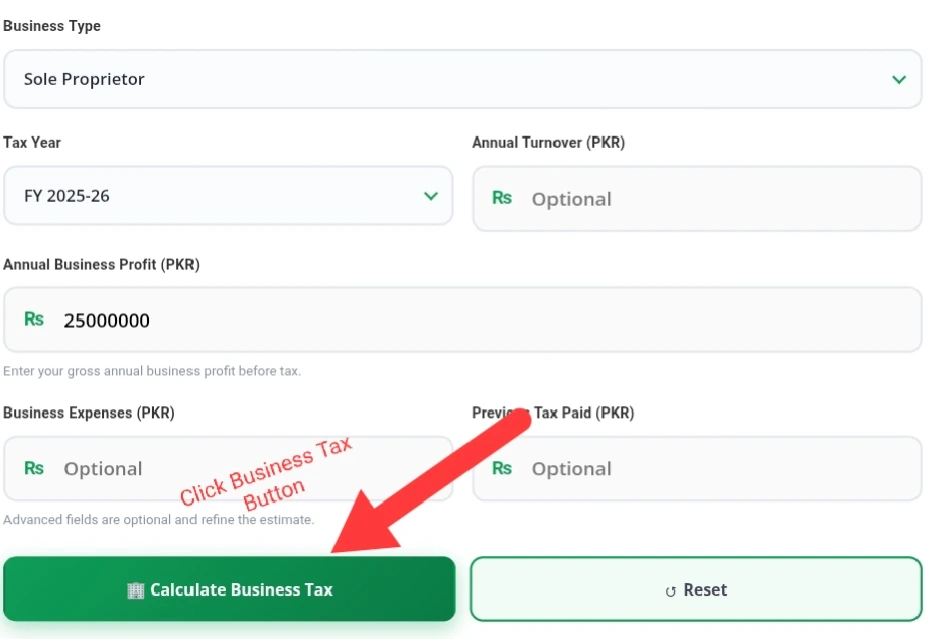
1- First choose the business type such as sole proprietor, AOP / Partnership and company.
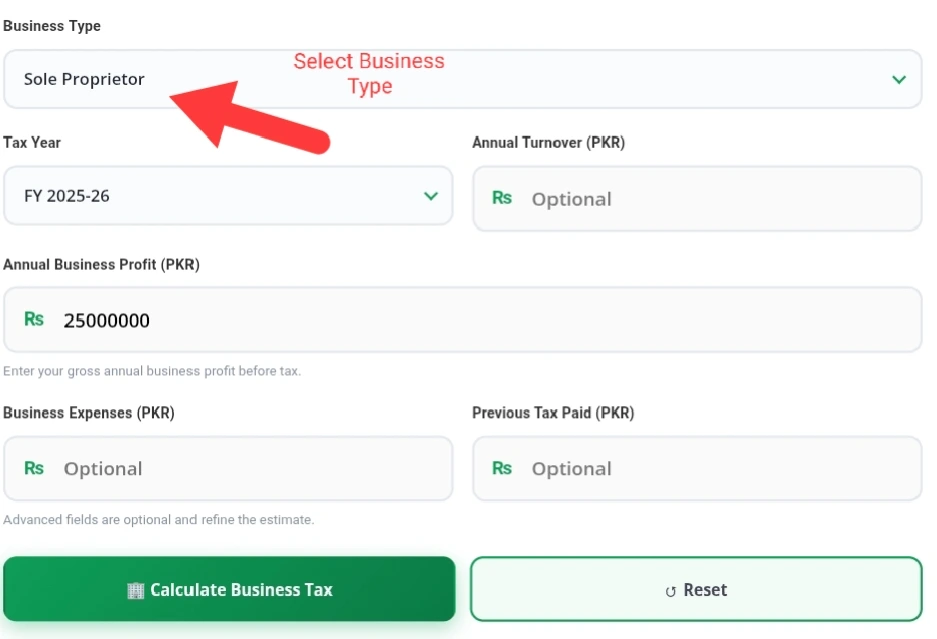
2- Choose the tax year.
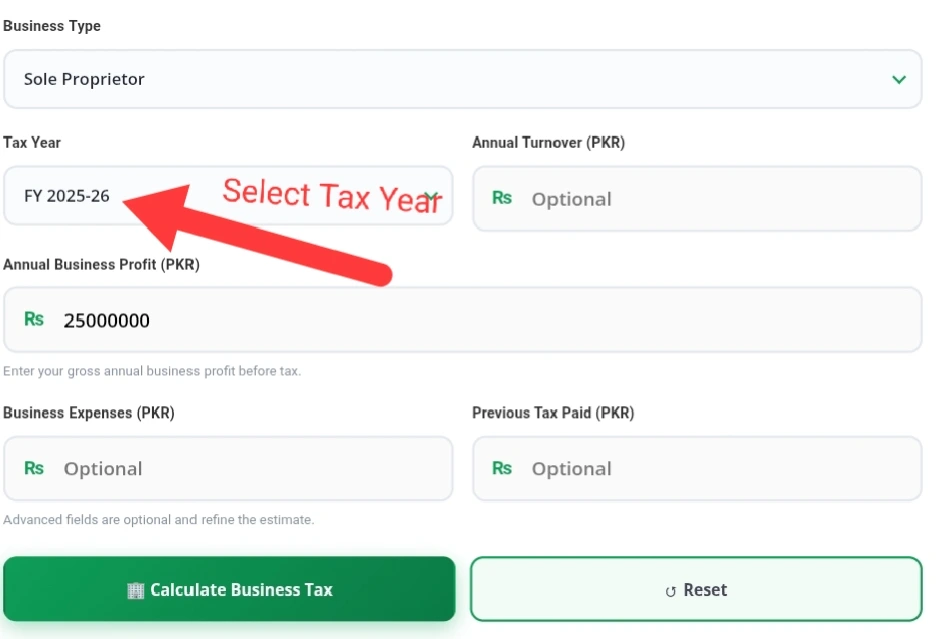
3- Select the annual turnover which is optional.
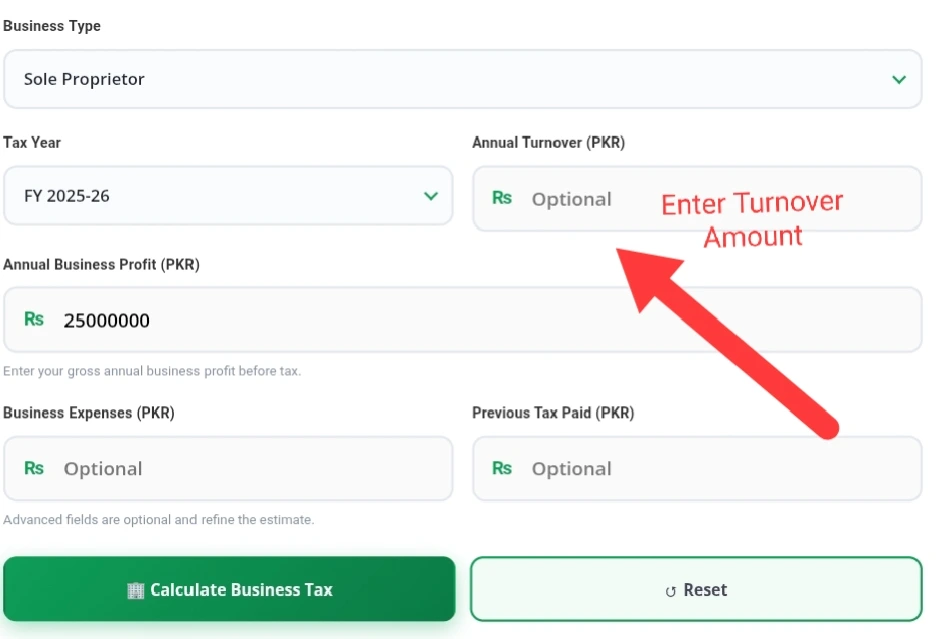
4- Enter the annual business profit in PKR.
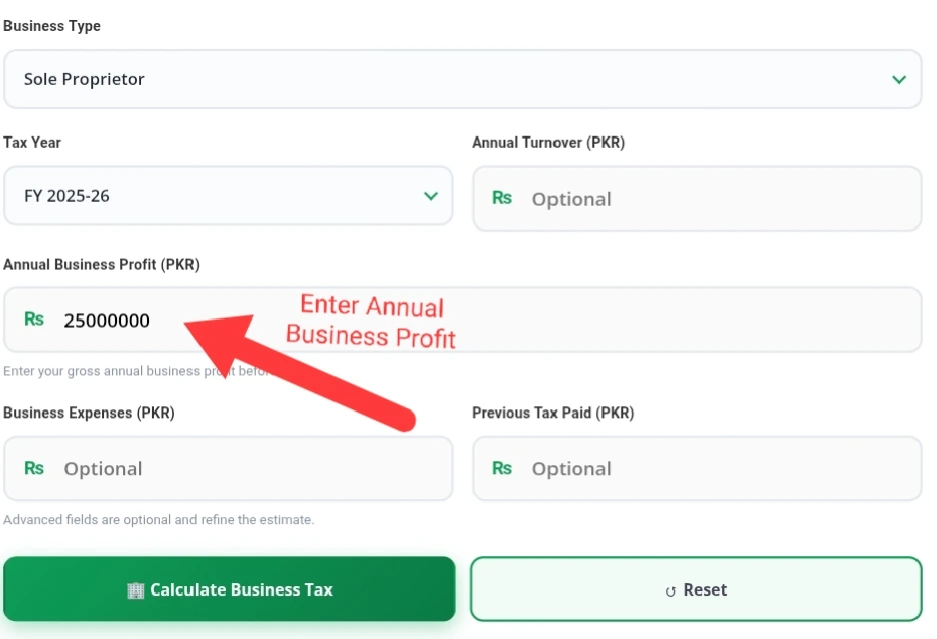
5- After all these steps click on the calculate business tax button.
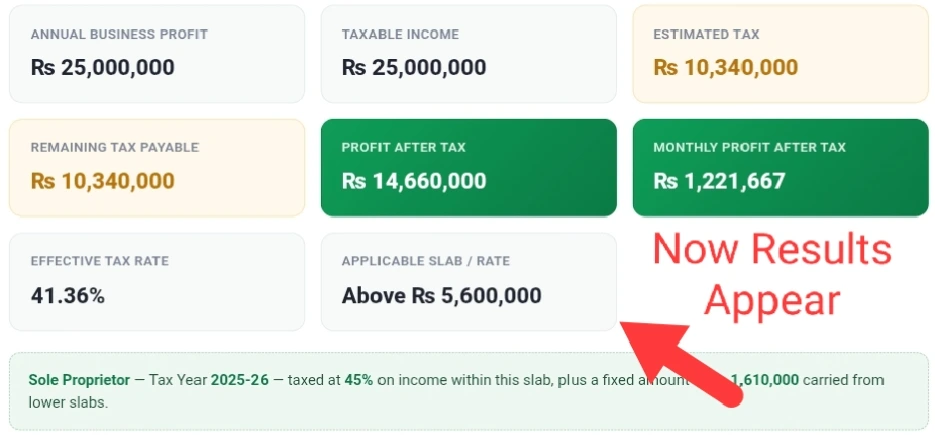
6- Congratulations! Your business tax appear.
Turnover, Revenue, Profit, and Taxable Income: What Goes Where
Before you enter numbers into the calculator and it helps to know which figure is which:
- Annual turnover: The total amount your business received from sales and services in the year, before subtracting any expenses. Enter this in the turnover field.
- Net profit: turnover minus your business expenses (rent, salaries, supplies, and so on). This is closer to what you actually kept.
- Taxable business income: Net profit after further tax-specific adjustments, such as depreciation rules and allowable deductions. This is the figure the income tax slabs actually apply to and it is usually a little different from your accounting net profit.
If you are not sure of your exact taxable income and your net profit figure is a reasonable starting estimate for the calculator. Your turnover figure is used separately to check whether minimum turnover tax applies.
How Business Income Tax Works in Pakistan
Business income tax in Pakistan is calculated two ways and you pay whichever is higher.
- Tax on your net taxable business income, calculated as turnover minus allowable business expenses, under progressive slabs (individuals and AOPs) or a flat rate (companies).
- Minimum turnover tax under Section 113, a flat percentage of your gross turnover, charged regardless of profit and loss.
If your income-based tax is lower than the turnover tax floor then you pay the turnover tax instead. This is why a business with thin margins can end up paying more than the slab rate suggests.
Taxable Business Income: Individual & AOP Slabs
These rates apply to sole proprietors and Associations of Persons (AOPs) on net taxable business income.
| Annual Taxable Business Income | Tax Rate |
|---|---|
| Up to Rs 600,000 | 0% |
| Rs 600,001 – Rs 1,200,000 | 15% of the amount exceeding Rs 600,000 |
| Rs 1,200,001 – Rs 1,600,000 | Rs 90,000 + 20% of the amount exceeding Rs 1,200,000 |
| Rs 1,600,001 – Rs 3,200,000 | Rs 170,000 + 30% of the amount exceeding Rs 1,600,000 |
| Rs 3,200,001 – Rs 5,600,000 | Rs 650,000 + 40% of the amount exceeding Rs 3,200,000 |
| Above Rs 5,600,000 | Rs 1,610,000 + 45% of the amount exceeding Rs 5,600,000 |
A 10% surcharge applies on top of this if annual taxable income exceeds Rs 10 million.
Worked Example
A sole proprietor with Rs 2,400,000 in net taxable business income falls in the Rs 1,600,001–Rs 3,200,000 slab. That’s Rs 800,000 above the threshold, taxed at 30% (Rs 240,000), plus the fixed Rs 170,000. Estimated tax: Rs 410,000.
Turnover Tax in Pakistan (Section 113 Minimum Tax)
If your turnover is Rs 10 million or more (individuals/AOPs) or you operate as a company, you’re also subject to minimum tax on turnover, whichever of these applies to your sector.
| Category | Minimum Tax Rate |
|---|---|
| Standard rate (most businesses) | 1.25% of turnover |
| Traders with turnover up to Rs 100 million | 0.5% of turnover |
| Distributors/wholesalers of specified goods (packaged goods, mobile phones, fertilizers, sugar, and electronics) | 0.5% of turnover |
You pay the higher of this turnover tax and your income-based tax, not both. This matters most for high-turnover, low-margin businesses, such as traders and distributors, where profit is a small slice of revenue. Since turnover tax ignores profit entirely, a business earning very little on high sales volume can still owe more under this rule than its actual profit would suggest under the slab rates.
Worked Example
A trading business with Rs 15,000,000 turnover and Rs 1,800,000 net taxable income: income tax at the slab rate comes to roughly Rs 355,000. Minimum turnover tax at 1.25% comes to Rs 187,500. Since the income-based tax is higher here, that’s what’s payable. If margins were thinner and income-based tax fell below Rs 187,500, the turnover tax would apply instead.
Company (Corporate) Tax Rates
If you operate as a registered company rather than a sole proprietorship or AOP.
- Standard companies: 29% of taxable income
- Small companies (as defined under the Income Tax Ordinance): 20%
- SME manufacturers, turnover up to Rs 100 million: 7.5%; turnover up to Rs 250 million: 15%
- Minimum turnover tax under Section 113 still applies as a floor at the rates above.
Allowable Deductions
Before tax is calculated, legitimate business expenses reduce your taxable income:
- Rent, utilities, and salaries paid for business operations
- Depreciation on business assets
- Zakat and approved pension contributions
- Documented business-related travel and professional fees
Keep records for all of these. FBR can request supporting documentation during an audit.
FAQs
What is the difference between income tax and turnover tax for a business?
Income tax is calculated on your net profit after expenses. Turnover tax is a minimum charge on your gross revenue, regardless of profit. You pay whichever is higher.
Does every business pay turnover tax?
It generally applies once turnover reaches Rs 10 million for individuals and AOPs. Companies are subject to it regardless of turnover level, though at reduced rates for certain sectors.
Is a small business below Rs 600,000 tax-free?
Yes, for individuals and AOPs, net taxable business income up to Rs 600,000 is exempt from income tax. Turnover tax rules are separate and depend on turnover level, not just profit.
Can I claim business losses if I pay minimum turnover tax?
Turnover tax paid in a loss-making year can typically be carried forward and adjusted against future tax liability, subject to conditions. A tax consultant can confirm eligibility for your specific case.
Are SME manufacturers taxed differently?
Yes. SME manufacturers with turnover up to Rs 100 million pay 7.5%, and those up to Rs 250 million pay 15%, both lower than the standard 29% company rate.
How do I calculate taxable business income?
Start with your annual turnover, subtract your allowable business expenses to calculate your net profit, then make any tax adjustments required under the Income Tax Ordinance, such as allowable depreciation. The final figure is your taxable business income, which is used to calculate your income tax.
Which business expenses are generally deductible?
Rent, salaries, utilities, depreciation on business assets, and documented professional and travel expenses directly related to running the business are generally deductible. Personal expenses and undocumented costs are not.
What happens if my business reports a loss?
You generally won’t owe income tax for that year, but minimum turnover tax under Section 113 may still apply if your turnover crosses the relevant threshold. Business losses can typically be carried forward against future profits, subject to conditions under the Income Tax Ordinance.
Where do I file business tax returns?
Through FBR’s IRIS portal at iris.fbr.gov.pk. The typical deadline for individuals and AOPs is September 30; companies typically follow a December 31 deadline depending on their financial year.
This page reflects publicly available information on business and turnover taxation under the Income Tax Ordinance, 2001, and Finance Act 2026. Rates vary by sector and can change through SROs. Confirm current figures on fbr.gov.pk and with a registered tax consultant before filing.