Freelancer Tax Calculator Pakistan
This Freelancer Tax Calculator Pakistan tool gives you an estimated tax calculation for income earned from Upwork, Fiverr, direct foreign clients, and local Pakistani clients. Enter your income, select how you receive it, and get a result based on the correct FBR treatment for your situation.
Freelance income in Pakistan isn’t taxed the same way for everyone. Where your payment comes from, and how it’s received, changes the applicable rate significantly.
🧑💻 Freelancer Tax Calculator Pakistan
FBR Section 154A · PSEB & Non-PSEB Registered Freelancers
| Income Type | Rate | Taxable Amount | Tax Charged |
|---|
More Related Calculators
How Freelancer Tax Calculator Are Works?
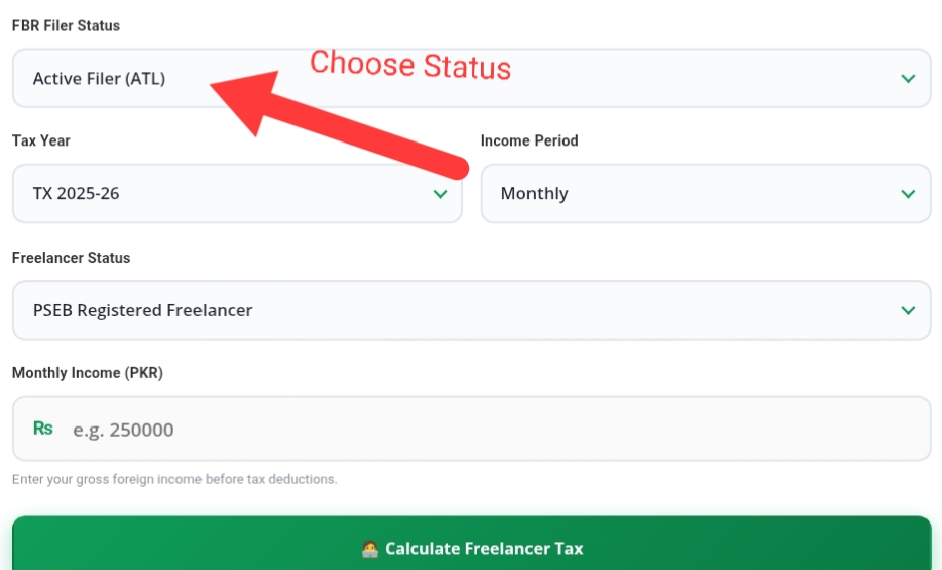
1- First you can choose the FBR filer status such as Active filer (ATL), and Non-filer.
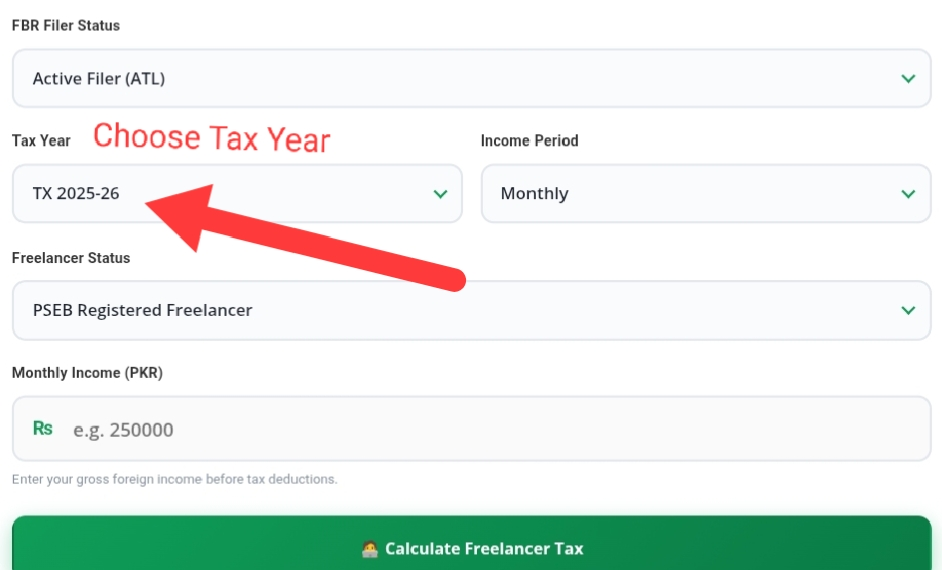
2- Then you need to choose the freelance tax year which you can check.
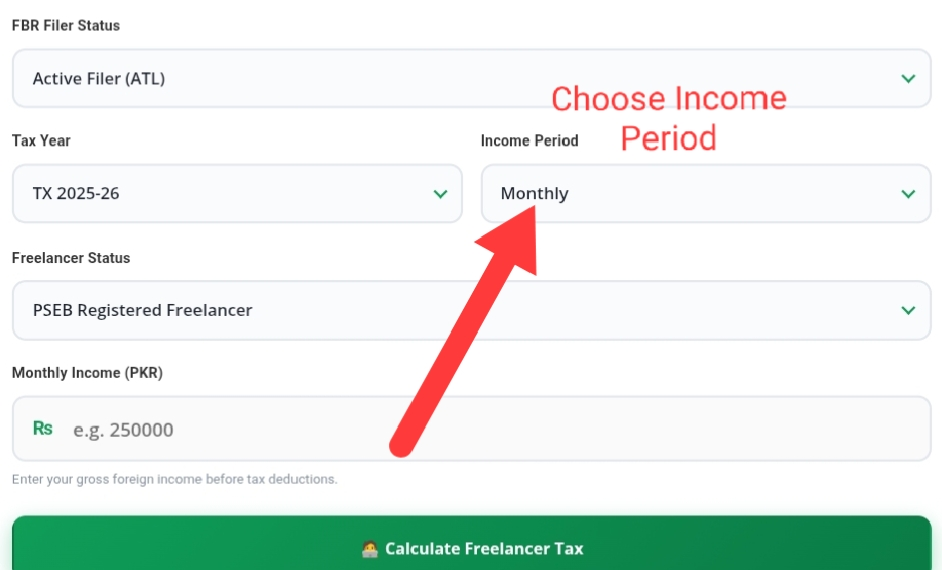
3- Select the income period method such as monthly and annually.
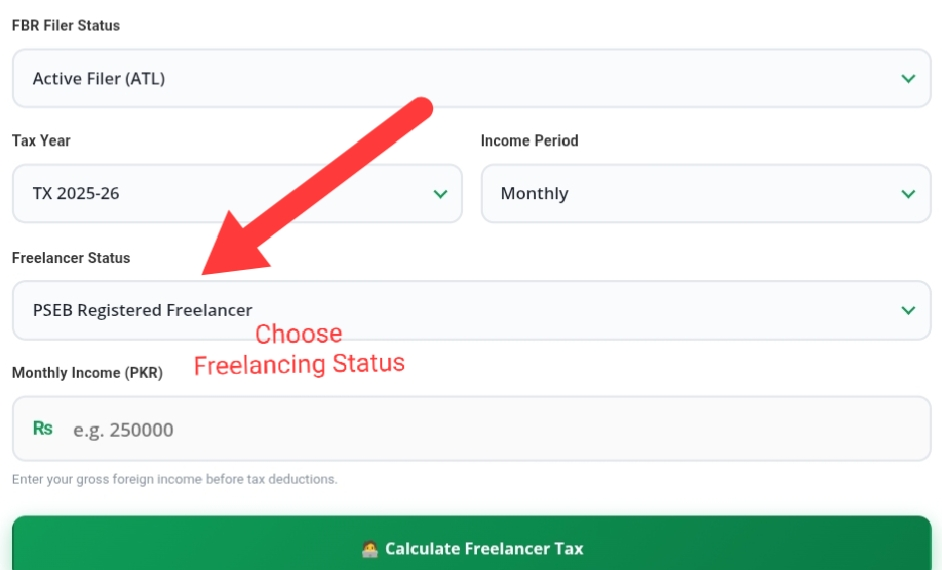
4- Select the Freelancer status such as PSEB Registered Freelancer and Non-PSEB Registered Freelancer.
5- Enter the Freelancing monthly income in PKR in the input box.
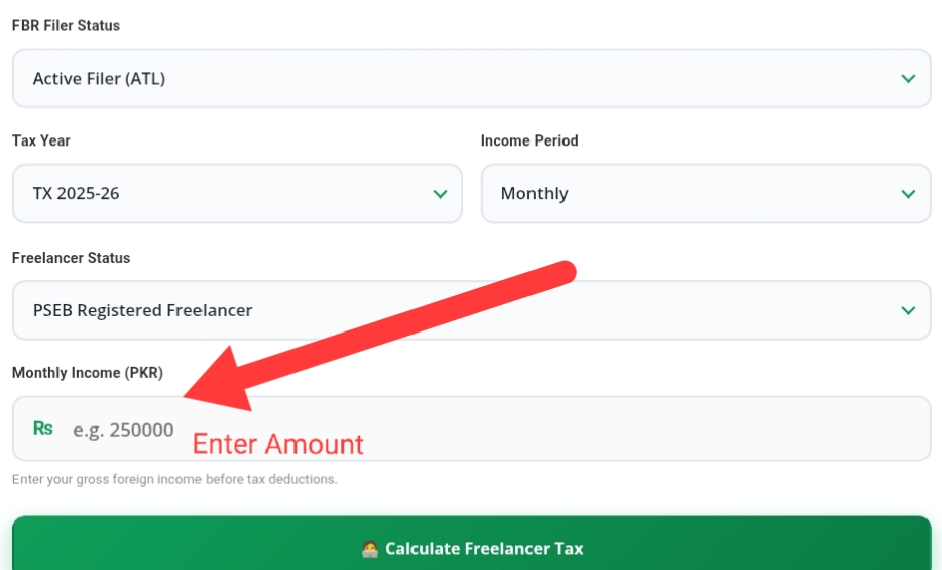
6- Now click on the freelance tax button.
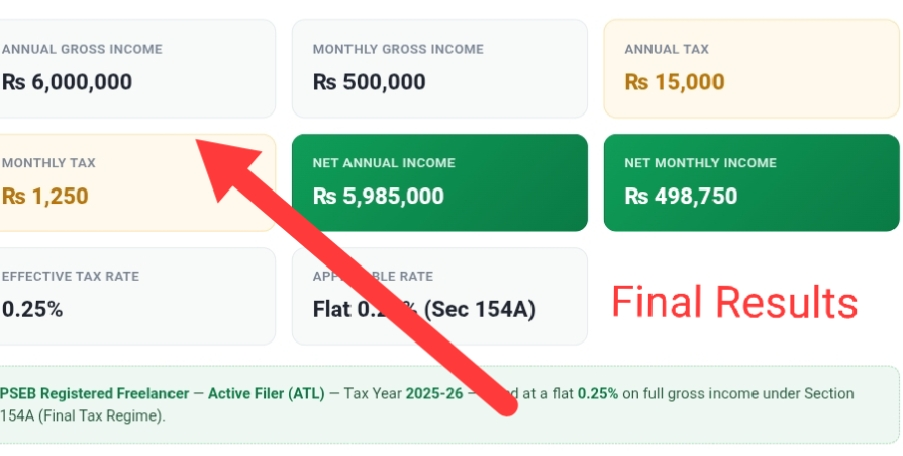
How This Calculator Estimates Your Tax
The calculator applies FBR’s rules based on the details you provide and your annual income, whether it is export and local income, your PSEB registration status, and whether you are on the Active Taxpayer List (ATL). Each of these factors changes which rate table applies and what rate within it you fall under.
The result is an estimate only, based on publicly available FBR rules at the time of calculation. It is not legal and tax advice, and it doesn’t account for every individual circumstance, such as unusual deductions, mixed income sources, and pending FBR clarifications. For your actual filing, confirm the figures on fbr.gov.pk and with a registered tax consultant.
Why Freelancer Tax in Pakistan Isn’t One Simple Rate
FBR doesn’t use “freelancer” as a formal tax category. For tax purposes, freelance income falls under business and professional income, but a separate and more favorable regime applies if that income is genuinely export income. Understanding freelancer tax in Pakistan starts with knowing which of these two categories your income falls under, since the two paths lead to very different tax bills.
- Export income (foreign clients, paid through proper banking channels) can qualify for a flat and final tax rate as low as 0.25%.
- Local income (Pakistani clients, and income that doesn’t meet export conditions) is taxed under the standard progressive business income slabs and which run higher than salaried rates at most brackets.
Tax on Freelancers Earning From Foreign Clients (Export Income)
If you are paid by clients outside Pakistan, through Payoneer, Wise, direct bank wire, and a similar channel then your income may qualify for the IT and IT-enabled services (ITeS) export regime under Section 154A of the Income Tax Ordinance, 2001.
| Category | Active Taxpayer (ATL) | Non-Filer (Non-ATL) |
| PSEB-registered exporter | 0.25% | 0.5% |
| Any other qualifying export case | 1% | 2% |
Source: FBR Withholding Income Tax Rate Card, Section 154A, Division IVA of Part III of the First Schedule. The 0.25% PSEB rate has been extended through Tax Year 2029 under the Finance Act 2026.
It is charged as a final tax on the gross amount received, meaning once this withholding is deducted and there is no additional progressive tax on that income. It applies if you are a developer, designer, writer, digital marketer, and consultant, as long as the underlying service qualifies as IT and IT-enabled and the payment is properly documented. Notice the table above: filing your return and staying on the Active Taxpayer List cuts this rate in half, regardless of PSEB status.
Conditions for the Reduced Export Rate
To qualify then you generally need to meet these conditions below.
- The income must genuinely be from IT and IT-enabled services provided to a client outside Pakistan.
- Payment must be received through an approved banking channel like as a Pakistani bank account, a Payoneer account linked to a local bank and a similar documented transfer.
- You must hold a valid NTN and file your annual return.
- For the 0.25% rate specifically, you need active PSEB registration.
If any of these conditions aren’t met then the reduced rate doesn’t apply and the income is instead taxed under the standard business slabs described below. This can happen, for example, if payment comes through an informal channel and the service doesn’t qualify as IT/ITeS.
Worked Example: Export Income
A PSEB-registered developer earning $2,000 a month from a US client, paid via Payoneer to a linked Pakistani bank account and gives a useful picture of how this works. That’s roughly Rs 560,000 a month, and Rs 6,720,000 a year, at a sample exchange rate.
- Applicable rate: 0.25% (PSEB-registered, active filer)
- Tax: 0.25% × Rs 6,720,000 = Rs 16,800 for the year
- It is a final tax and no further progressive tax applies to this income
Set that against the same income taxed as local business income under the non-salaried slabs below and the difference becomes clear. It is exactly why PSEB registration and proper banking documentation matter so much for exporters. If you are unsure whether your setup qualifies then our business income tax calculator can help you compare both treatments side by side.
YouTube, AdSense, and Content Creator Income
Freelancers earning from platforms like YouTube AdSense and other social media monetization face a separate treatment. Finance Act 2026 introduced a specific 5% withholding under Section 154B for revenue received from social media platforms then which is distinct from the ITeS export regime above.
For resident creators on the Active Taxpayer List, this 5% acts as a minimum tax and it is adjustable against your actual annual liability but your tax on this income can’t fall below 5%. For non-residents without a permanent establishment in Pakistan then the 5% is a final tax with no further computation.
Tax on Freelancers Earning From Local Clients
If your clients are based in Pakistan and if your income doesn’t meet the export conditions above then it is taxed as ordinary business income under the progressive slabs that apply to non-salaried individuals and Associations of Persons (AOPs). These slabs are separate from the salaried tax table and notably higher.
| Annual Taxable Income | Tax Rate |
| Up to Rs 600,000 | 0% |
| Rs 600,001 – Rs 1,200,000 | 15% of the amount exceeding Rs 600,000 |
| Rs 1,200,001 – Rs 1,600,000 | Rs 90,000 + 20% of the amount exceeding Rs 1,200,000 |
| Rs 1,600,001 – Rs 3,200,000 | Rs 170,000 + 30% of the amount exceeding Rs 1,600,000 |
| Rs 3,200,001 – Rs 5,600,000 | Rs 650,000 + 40% of the amount exceeding Rs 3,200,000 |
| Above Rs 5,600,000 | Rs 1,610,000 + 45% of the amount exceeding Rs 5,600,000 |
Non-salaried individuals and AOPs with annual taxable income above Rs 10 million also pay a 10% surcharge on their income tax and one point higher than the surcharge that used to apply to salaried individuals and one that hasn’t been removed for this category.
Why the Difference Is So Significant
At Rs 2,000,000 in annual income, a salaried person pays roughly Rs 94,000 in tax. A freelancer earning the same amount from local clients, taxed under the non-salaried table, pays roughly Rs 290,000, about three times more. This gap narrows at higher incomes but never closes and which is exactly why the export income concession above is worth pursuing if any part of your client base is international.
Non-salaried individuals also pay quarterly advance tax installments rather than having tax withheld at source and since there is no employer to deduct it automatically.
Worked Example: Local Income
Take a graphic designer earning Rs 200,000 a month entirely from Pakistani clients. That’s Rs 2,400,000 a year, which falls in the Rs 1,600,001–Rs 3,200,000 non-salaried slab.
- Amount above Rs 1,600,000: Rs 800,000
- Tax at 30%: Rs 240,000
- Plus the fixed Rs 170,000 for this bracket
- Total estimated annual tax: Rs 410,000, paid through quarterly advance installments rather than final withholding
That’s considerably higher than the export example above for a comparable income level and a gap that makes checking your export eligibility worthwhile if any of your clients are international.
Earning From Both Local and Foreign Clients
Many Pakistani freelancers earn from a mix of sources and an international Upwork client alongside a local business.
for example. In this situation, each income stream is generally assessed on its own terms rather than blended into a single rate.
- Income that qualifies as export income (foreign client, proper banking channel, IT/ITeS service) is taxed under the Section 154A final tax regime described above.
- Income from local clients and foreign income that doesn’t otherwise meet the export conditions, is taxed under the non-salaried business slabs.
- Your total annual liability is the sum of tax calculated separately on each stream, not a single blended rate applied to combined income.
It is worth keeping separate records for local and export earnings from the start, including which bank account and channel each payment came through, rather than reconstructing the split at filing time. Doing so also makes it easier to demonstrate to FBR, if asked, which portion of your income qualifies for the reduced export rate.
Allowable Deductions for Freelancers
Before your tax is calculated then a few legitimate business expenses and deductions can reduce your taxable income.
- Platform commission — for example, Fiverr’s service fee can typically be claimed as a business expense against your gross earnings.
- Internet, phone, and software subscriptions used for your freelance work.
- Zakat paid under the Zakat and Ushr Ordinance
- Approved pension fund contributions
- Tax credits for approved donations and in some cases, education expenses
Keep receipts and records. FBR generally expects documentation to be retained for several years in case of an audit. If you are also weighing whether to register as a sole proprietor versus staying an unregistered freelancer then our business income tax calculator covers that comparison in more detail.
Why Filer Status Matters More for Freelancers
Being on FBR’s Active Taxpayer List (ATL) affects freelancers more directly than most other taxpayers, since freelance income routes through banking channels FBR actively monitors.
- IT services withholding is generally lower for active filers than for non-filers.
- Non-filers face higher withholding on banking transactions, property, and vehicle purchases.
- Some export income concessions require ATL status to remain valid.
Registering for an NTN and filing on time, even if your income is below the exemption threshold then keeps these benefits available and avoids the higher default rates applied to non-filers. Our guide on filer versus non-filer status breaks down exactly what these benefits are worth across different transaction types.
Common Mistakes Freelancers Make When Filing
A few recurring errors cause freelancers to overpay, underpay, and run into issues with FBR:
- Assuming every foreign payment automatically qualifies as export income. Export treatment depends on the service genuinely being IT and IT-enabled and the payment routing through a proper banking channel, not simply on the client being based abroad.
- Not maintaining banking records. Payment proofs, bank statements, and PSEB documentation are what support your claimed tax treatment if FBR reviews your return. Without them, a lower rate can be difficult to defend.
- Confusing local income with export income. Freelancers with both local and foreign clients sometimes report everything under one treatment. Each stream needs to be identified and taxed correctly on its own terms.
- Missing the PSEB registration step. Freelancers often qualify for the general 1% export rate but skip PSEB registration, missing out on the lower 0.25% rate for no added compliance effort once registered.
- Filing late and not at all. Late and non-filing affects ATL status directly, which in turn changes the withholding rate applied to future export payments.
FAQs
Do freelancers in Pakistan have to pay income tax?
What is the tax rate for Upwork and Fiverr income?
If it qualifies as export income received through a proper banking channel then it can be taxed at 0.25% (PSEB-registered) and 1% (general rate) as a final tax. If it doesn’t qualify then it is taxed under standard business income slabs instead.
Do I need to register with PSEB to get a lower rate?
PSEB registration is required specifically for the 0.25% concessional rate. Without it, qualifying export income is generally still taxed at 1%, which is lower than standard business slabs but higher than the PSEB rate.
Is freelance income below Rs 600,000 tax-free?
Under standard business income rules, income up to Rs 600,000 annually is exempt. Export income taxed under the final tax regime is calculated differently, since it’s a flat rate on gross receipts rather than a progressive slab system.
What if I earn from both local and foreign clients?
Each income stream is generally assessed separately like export income under the final tax regime, and local income under the standard business slabs. Your total liability depends on the split between the two. See the mixed income section above for how to keep records for each stream.
Does Payoneer income qualify as export income?
It can, provided the underlying service qualifies as IT and IT-enabled and the funds are received through a Payoneer account properly linked to a local Pakistani bank. FBR receives data on these transactions, so accurate reporting matters.
Conclusion
Getting freelance tax Pakistan calculations right comes down to one question: does your income qualify as export income, and not? That single distinction decides whether you pay a fraction of a percent and a much steeper progressive rate. Run your numbers through the calculator above and keep your local and export earnings in separate records from day one, and register with PSEB if any part of your work qualifies.
It is a small step that pays for itself quickly. When you are ready to file, confirm the details directly on fbr.gov.pk and with a registered tax consultant, since rates and conditions can shift with each Finance Act.
References
This article references the following official sources.
- Income Tax Ordinance, 2001
- Finance Act 2026
- FBR Withholding Income Tax Rate Card (Section 154A, Division IVA of Part III of the First Schedule)
- Section 154A, Export of Services (IT and IT-enabled services)
- Section 154B, Withholding on social media platform revenue
- First Schedule, Part I, Division I (non-salaried individuals and AOPs)
This page reflects publicly available information on freelancer, export income, and non-salaried business taxation, cross-checked against FBR’s official Withholding Income Tax Rate Card and Finance Act 2026 reporting. Rates, conditions, and PSEB requirements can change through subsequent SROs and FBR notifications. Confirm current figures on fbr.gov.pk and with a registered tax consultant before filing.