Super Tax Calculator in Pakistan
This Super Tax Calculator in Pakistan tool estimates your liability under Section 4C of the Income Tax Ordinance, 2001. Enter your annual taxable income and sector, and get your estimated super tax instantly, based on the updated Finance Act 2026 rates.
Super tax is a separate charge on top of regular income tax, applying only to individuals, AOPs, and companies whose annual taxable income exceeds Rs 150 million. It is calculated on total taxable income at a flat rate determined by an income slab, not progressively like standard income tax slabs.
🇵🇰 Super Tax on High Earning Persons
Tax Year 2026-27 · Section 4C, Income Tax Ordinance 2001
| Income Threshold (PKR) | Rate | Taxable Income | Super Tax Charged |
|---|
More Related Calculators
How to Use This Super Tax Calculator
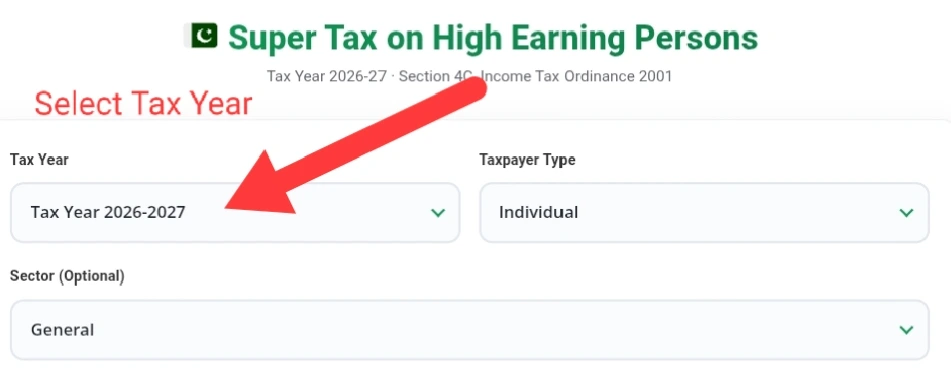
1- Choose the tax year first like 2026-2027.
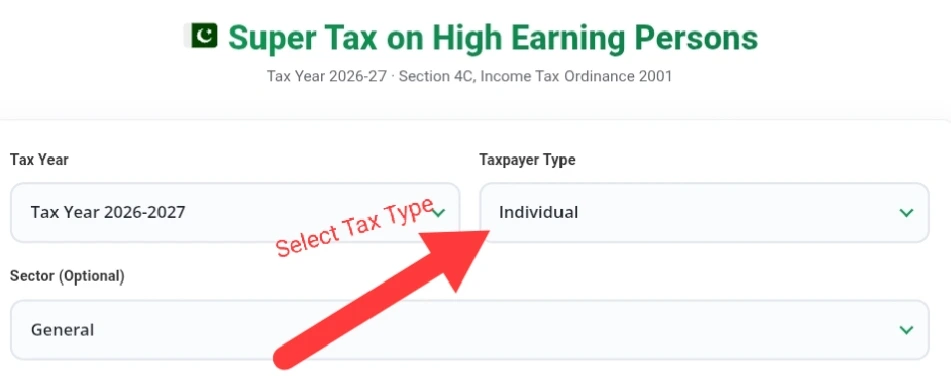
2- Choose the taxpayer type like individual, AOP, and Company.
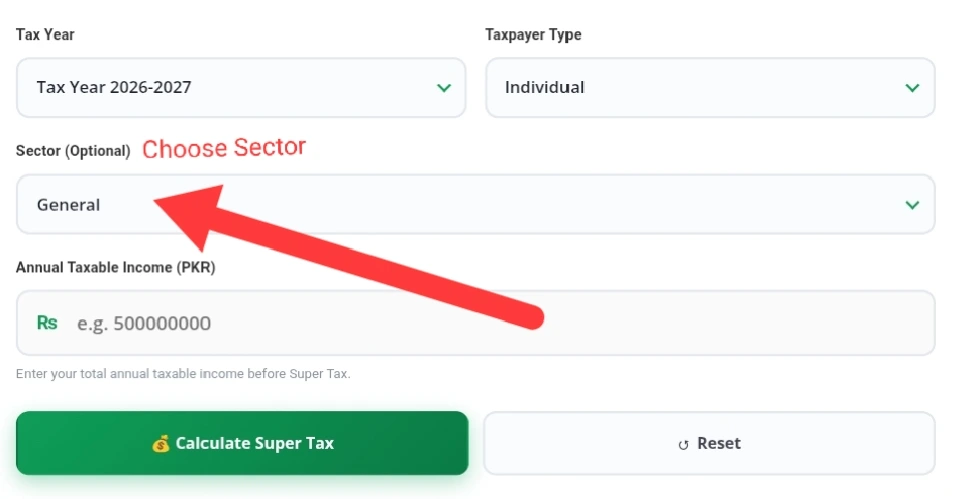
3- Choose the sector such as General, Banking, Exploration & Productions and Fertilizers. Make sure this is optional features.
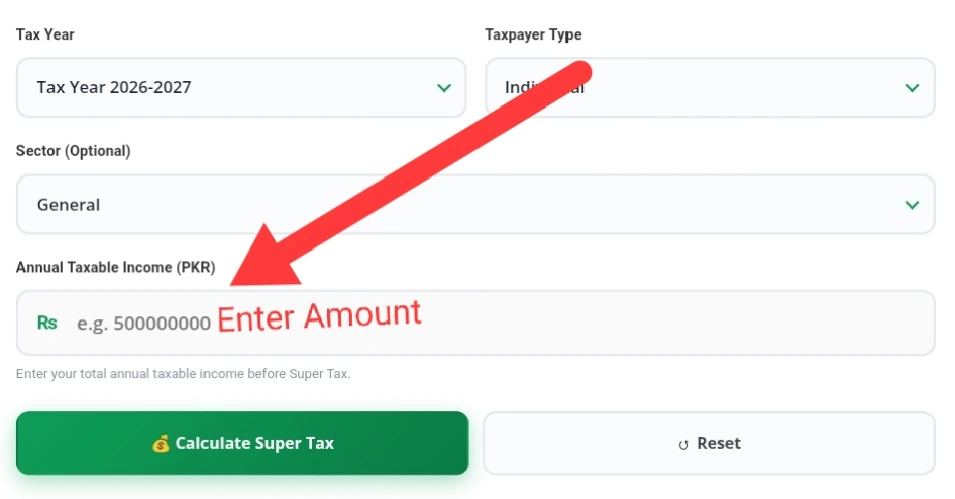
4- Enter the annual taxable income in PKR.
5. Now time to click on the calculate tax button.
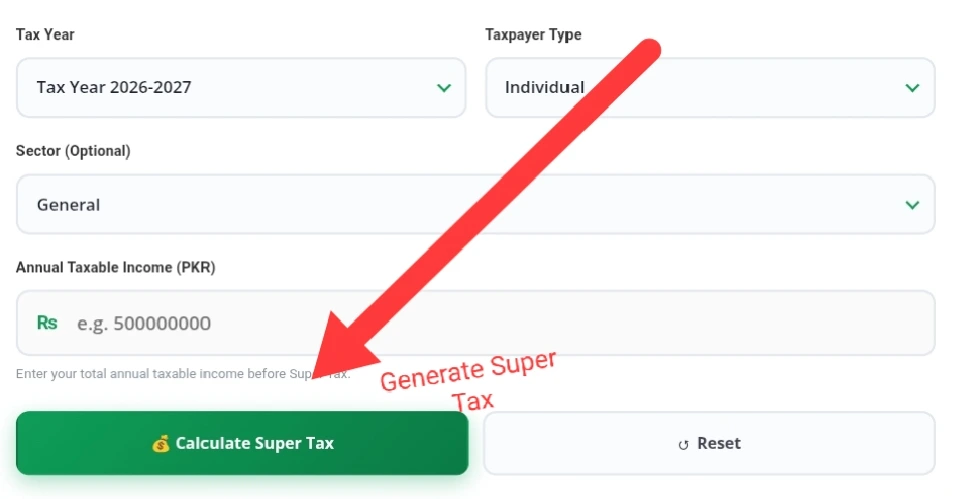
Now you can see the tax calculations results.
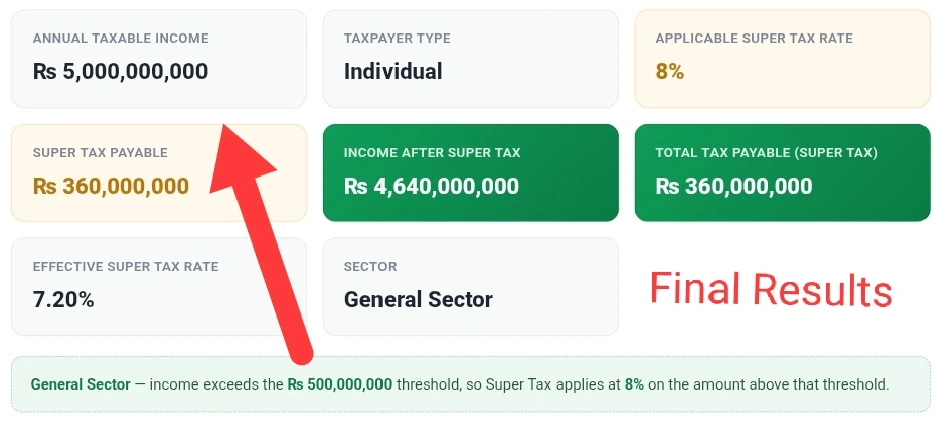
How to Read Your Results
- Applicable Slab — the income bracket your taxable income falls into, based on the tables below.
- Super Tax Rate — the flat percentage that applies to your entire taxable income at that slab, not just the portion above the threshold.
- Estimated Super Tax — your taxable income multiplied by the applicable rate. This is calculated separately from your regular income tax or corporate tax.
- Total Estimated Tax Liability — where shown, this combines your regular income tax (or corporate tax) with super tax, giving a fuller picture of what you owe.
If your income falls below Rs 150 million, the calculator will show a result of Rs 0, since super tax simply doesn’t apply.
What You’ll Need Before Calculating
- Your annual net taxable income for the relevant tax year, from your financial statements or tax return
- Confirmation of your taxpayer category (individual, AOP, or company)
- Your sector classification, particularly if you operate in banking, oil and gas exploration, or fertilizer manufacturing
- Your Active Taxpayer List (ATL) status, since this affects related charges like the income tax surcharge, even though it doesn’t change the super tax rate itself
Who Pays Super Tax in Pakistan
Super tax under Section 4C applies broadly, but the details differ by taxpayer type:
- Individuals — Any individual, including high-net-worth professionals, sole proprietors, or landlords, with annual taxable income above Rs 150 million is liable, regardless of income source.
- Associations of Persons (AOPs) — Partnerships and AOPs are assessed the same way as individuals, based on the AOP’s total taxable income for the year.
- Companies (standard sectors) — Manufacturing, trading, services, textile, cement, steel, telecom, and pharmaceutical companies fall under the standard sector table, which now carries 0% for income between Rs 150 million and Rs 500 million under Finance Act 2026.
- Banks — Banking companies pay a flat 10% once taxable income exceeds Rs 150 million, with no intermediate slabs and no relief under Finance Act 2026.
- Exploration & Production (E&P) companies — Oil and gas exploration firms are excluded from the 2026 relief and are instead governed by a separate rule under Rule 4 of the Fifth Schedule to the Income Tax Ordinance, distinct from both the standard table and the flat 10% rate.
- Fertilizer manufacturers — Also excluded from the relief, fertilizer sellers pay a flat 10% once income exceeds Rs 150 million, the same treatment as banks.
- Other high-income entities — Any other person or entity type recognized under the Income Tax Ordinance, once their taxable income exceeds Rs 150 million, falls under the standard sector rules unless specifically carved out.
Who Does NOT Pay Super Tax
- Anyone with taxable income at or below Rs 150 million, regardless of sector or taxpayer type, owes no super tax for that year.
- A standard-sector company earning Rs 400 million, for example, now owes zero super tax under the Finance Act 2026 relief, even though it would have paid roughly Rs 24-32 million under the old rates.
- Salaried individuals rarely encounter super tax directly, since very few salaries exceed Rs 150 million annually. The separate income tax surcharge on income above Rs 10 million no longer applies to salaried individuals under Finance Act 2026; it now applies only to non-salaried individuals and AOPs.
- Small and medium enterprises (SMEs), as defined under Section 2(59A), typically operate well below the Rs 150 million threshold and are unaffected in most cases.
The Super Tax Formula
The calculation itself is simple once you know your slab and rate:
Super Tax = Total Taxable Income × Applicable Slab Rate
There’s no deduction of a threshold amount first. Once your income crosses into a slab, the full amount is taxed at that slab’s rate.
Formula Example
A standard-sector company with Rs 550 million in taxable income falls above the Rs 500 million threshold, so the 8% rate applies to the entire amount:
Rs 550,000,000 × 8% = Rs 44,000,000
Super Tax Rates — Tax Year 2027 (FY 2026-27)
Finance Act 2026 significantly reduced super tax for most sectors:
| Annual Taxable Income | Standard Sectors | Banks, E&P, Fertilizer |
| Up to Rs 150 million | 0% | 0% |
| Rs 150 million – Rs 500 million | 0% | 1% – 8% (graduated, see below) |
| Above Rs 500 million | 8% | 10% |
For most companies and businesses, the six intermediate slabs between Rs 150 million and Rs 500 million have been reduced to zero. The top rate above Rs 500 million was cut from 10% to 8%. Banks, exploration and production (E&P) companies, and fertilizer manufacturers are excluded from this relief and continue under the previous structure.
Super Tax Rates for Excluded Sectors (Banks, E&P, Fertilizer)
Banks and fertilizer sellers are not on a graduated table. Per the Finance Bill 2026 memorandum, they continue to pay a flat 10% super tax once prescribed income exceeds Rs 150 million, with no intermediate slabs.
| Category | Super Tax Rate |
| Up to Rs 150 million | 0% |
| Above Rs 150 million (Banks) | 10% flat |
| Above Rs 150 million (Fertilizer manufacturers) | 10% flat |
| Oil & Gas Exploration & Production (E&P) | Governed separately under Rule 4 of the Fifth Schedule to the Income Tax Ordinance, not this table |
E&P companies don’t follow the standard graduated table or the flat 10% rate that applies to banks and fertilizer sellers. Their super tax is capped under a distinct formula in Rule 4 of the Fifth Schedule, so a specific figure can’t be given here without confirming that Schedule’s exact terms.
Unlike regular income tax, super tax applies the applicable rate to your entire taxable income, not just the portion within that slab. It isn’t calculated progressively.
Worked Examples
Example 1: Standard company, relief applies (zero tax) A textile manufacturer with Rs 300 million in taxable income falls entirely within the relieved Rs 150M-500M range. Under the old rules, this would have been taxed at 4%, roughly Rs 12,000,000. Under Tax Year 2027 rules, it owes Rs 0.
Example 2: Standard company, above the top threshold A trading company with Rs 600 million in taxable income:
- Old rate (pre-2026): 10% on the full amount = Rs 60,000,000
- New rate (Tax Year 2027): 8% on the full amount = Rs 48,000,000
Example 3: Excluded sector (E&P), mid-range income An E&P company with Rs 300 million in taxable income does not fall under the standard graduated table or the flat 10% rate. Its super tax is instead capped under Rule 4 of the Fifth Schedule to the Income Tax Ordinance, a separate statutory formula. A specific figure isn’t given here since it depends on that Schedule’s exact terms; confirm with a tax consultant or the Fifth Schedule text directly.
Example 4: Bank crossing the flat-rate threshold A bank with Rs 350 million in taxable income pays the flat 10% rate that applies to banks above Rs 150 million: Rs 35,000,000.
Example 5: Below the threshold (no super tax) An individual with Rs 140 million in taxable income falls below the Rs 150 million threshold entirely. Super tax owed: Rs 0. This individual may still owe regular income tax and, if applicable, the separate income tax surcharge.
Common Mistakes When Calculating Super Tax
- Applying the rate only to the amount above the threshold. Super tax isn’t progressive. The full rate applies to your entire taxable income once you’re in a slab, not just the excess.
- Confusing super tax with the income tax surcharge. These are two different charges with different thresholds (Rs 150 million vs. Rs 10 million) and different calculation methods.
- Assuming all companies got the Finance Act 2026 relief. Banks, E&P companies, and fertilizer manufacturers were specifically excluded and remain subject to higher, sector-specific rates.
- Using turnover instead of taxable income. Super tax is based on taxable income after allowable deductions, not gross revenue or turnover.
- Forgetting sector-specific flat rates. Banks and fertilizer sellers pay a flat 10% above Rs 150 million, not the graduated table used for standard sectors, and E&P companies follow a separate Fifth Schedule formula entirely.
Super Tax vs. Income Tax Surcharge
These are often confused but are separate charges:
- Super tax (Section 4C) applies to income above Rs 150 million, calculated on the full income amount.
- Income tax surcharge applies to non-salaried individuals and AOPs earning above Rs 10 million, calculated as 10% of the regular income tax payable, not on income directly. Salaried individuals no longer pay this surcharge under Finance Act 2026.
A company or high earner can owe both, depending on income level and structure.
Legal Basis
Super tax is governed by Section 4C of the Income Tax Ordinance, 2001. It was first introduced under Section 4B through the Finance Act 2015 to fund the rehabilitation of temporarily displaced persons. Finance Act 2022 introduced Section 4C, lowering the applicability threshold from Rs 500 million to Rs 150 million and broadening the slab structure. Finance Act 2023 standardized the top rate at 10% for income above Rs 500 million across most sectors. Finance Act 2025 reduced rates slightly for the Rs 250 million-Rs 500 million range. Finance Act 2026 introduced the most recent changes described on this page, reducing rates to zero for most sectors between Rs 150 million and Rs 500 million, while excluding banks, E&P companies, and fertilizer manufacturers from that relief.
Some aspects of Section 4C, particularly around adjustment and refund rights against withholding tax, remain subject to ongoing litigation before Pakistani courts as of mid-2026. This page reflects the rates currently in force; taxpayers with complex positions should confirm current status with a registered tax consultant.
FAQs
Is super tax still applicable in Pakistan for 2026-27?
Yes, but at reduced rates. Standard-sector taxpayers with income between Rs 150 million and Rs 500 million now pay 0%, and the top rate above Rs 500 million dropped from 10% to 8%. Banks, E&P companies, and fertilizer manufacturers are excluded from this relief.
Does super tax apply to individuals, or only companies?
It applies to individuals, AOPs, and companies alike, as long as annual taxable income exceeds Rs 150 million.
Why do banks and fertilizer sellers pay a flat 10% instead of the standard slabs?
Finance Act 2026 excluded banks and fertilizer sellers from the relief given to other sectors, keeping them at a flat 10% above Rs 150 million. E&P companies are also excluded, but follow a separate formula under Rule 4 of the Fifth Schedule rather than this flat rate.
Is super tax calculated progressively like income tax slabs?
No. Super tax applies the full applicable rate to your entire taxable income, unlike income tax, where only the portion within each bracket is taxed at that bracket’s rate.
How is super tax different from the income tax surcharge?
Super tax is a separate charge on income above Rs 150 million. The surcharge is a 10% addition to your regular income tax bill for non-salaried individuals and AOPs earning above Rs 10 million. They’re calculated differently and can both apply.
Where do I pay super tax?
It’s declared as part of your annual income tax return through FBR’s IRIS portal at iris.fbr.gov.pk, not filed separately.
Related Tax Calculators
- Business Income Tax Calculator Pakistan — for calculating regular income tax and turnover tax alongside super tax.
- Tax Calculator Pakistan — for salaried individuals checking standard income tax slabs.
- Freelancer Tax Calculator Pakistan — for freelancers and exporters checking export income and business tax treatment.
This page reflects publicly available information on super tax under Section 4C of the Income Tax Ordinance, 2001, as amended by Finance Act 2026. Some aspects of super tax remain subject to ongoing litigation regarding adjustment and refund rights. Confirm current figures on fbr.gov.pk or with a registered tax consultant before filing.